Showing posts with label Canada. Show all posts

Sunday, December 28, 2008

From sea to shining sea

Meaning
From one coast to another.

Origin
Taken from a line in 'America the Beautiful', the patriotic song written by Katharine Lee Bates in 1893. She wrote other versions later, in 1904 and 1913.
O beautiful for spacious skies,
For amber waves of grain,
For purple mountain majesties
Above the fruited plain!
America! America!
God shed his grace on thee
And crown thy good with brotherhood
From sea to shining sea!

She wrote the song following an inspirational visit to Pikes Peak, Colorado, USA, which she later described thus:
"One day some of the other teachers and I decided to go on a trip to 14,000-foot Pikes Peak. We hired a prairie wagon. Near the top we had to leave the wagon and go the rest of the way on mules. I was very tired. But when I saw the view, I felt great joy. All the wonder of America seemed displayed there, with the sea-like expanse."

The phrase is also frequently associated with Canada. The Canadian national motto - "A mari usque ad mare", translates as "From sea to sea". This has biblical origin:
"He shall have dominion from sea to sea and from the river unto the ends of the earth." (Psalm 72:8)

Source: http://www.phrases.org.uk/meanings/from%20sea%20to%20shining%20sea.html

Thursday, December 25, 2008

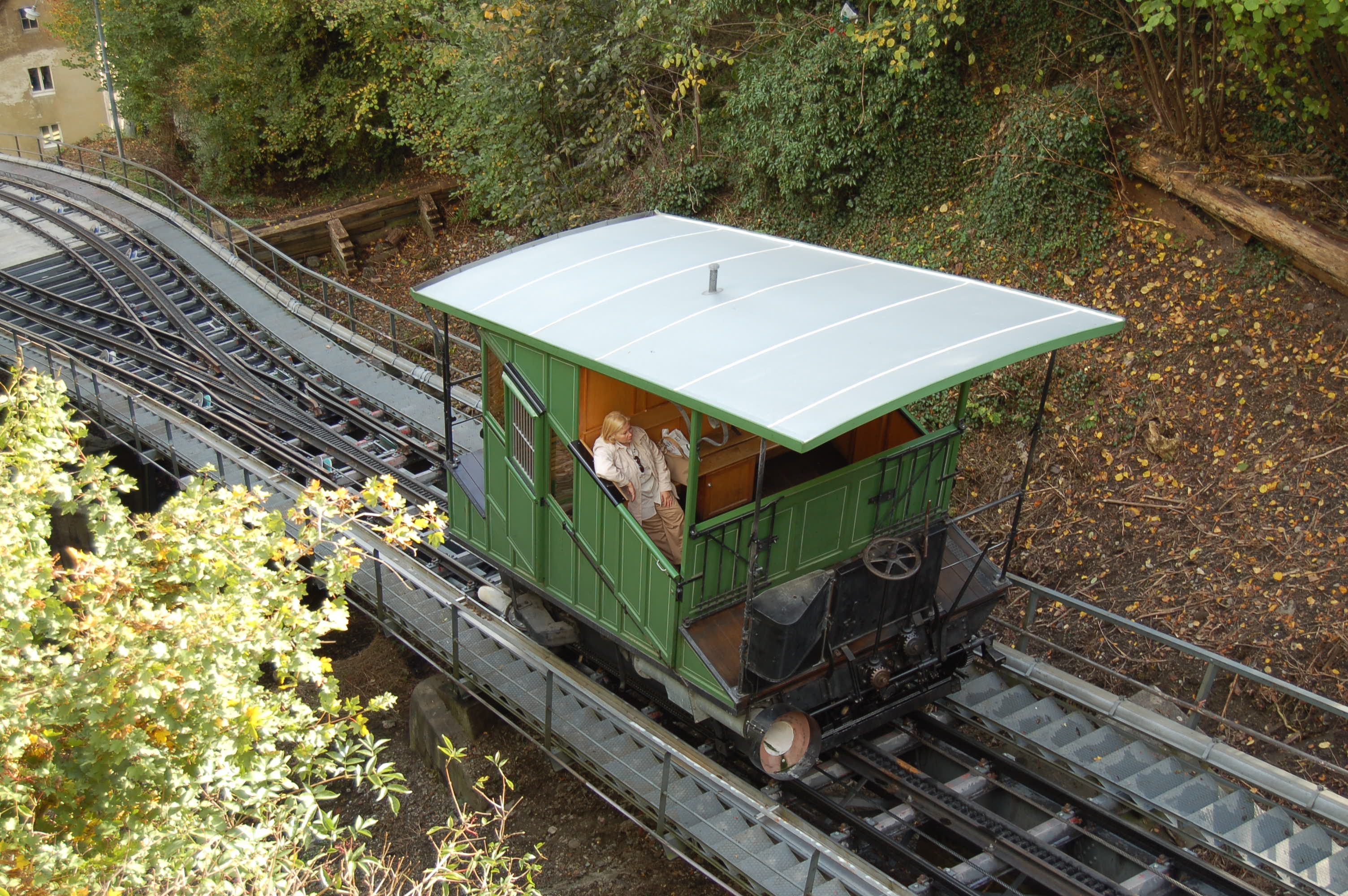
Funicular railway


A funicular, also known as a funicular railway, incline, inclined railway, inclined plane, or cliff railway, is a type of self-contained cable railway in which a cable attached to a pair of tram-like vehicles on rails moves them up and down a very steep slope, the ascending and descending vehicles counterbalancing each other.

The word is from the Latin funiculus, a diminutive of funis, "rope".

Tuesday, November 25, 2008

While and whilst

Whilst is synonymous with while in standard British English and Australian English; in American English and Canadian English, it can be considered pretentious or archaic.

Whilst is chiefly used in British English and Australian English. Whilst is synonymous with while in standard English, although to many it sounds slightly old-fashioned, and is rare or archaic. In their style guides, some modern publications on both sides of the Atlantic disapprove of its use (along with "amidst" and "amongst").

Tuesday, November 11, 2008

Remembrance Day


Why the Poppy?

Today, fields of brilliant poppies still grow in France.

A writer first made the connection between the poppy and battlefield deaths during the Napoleonic wars of the early 19th century, remarking that fields that were barren before battle exploded with the blood-red flowers after the fighting ended.

During the tremendous bombardments of the First World War the chalk soils became rich in lime from rubble, allowing 'popaver rhoeas' to thrive. When the war ended the lime was quickly absorbed, and the poppy began to disappear again.

After John McCrae's poem In Flanders Fields was published in 1915 the poppy became a popular symbol for soldiers who died in battle.

Three years later an American, Moina Michael, was working in a New York City YMCA canteen when she started wearing a poppy in memory of the millions who died on the battlefield.

During a 1920 visit to the United States a French woman, Madame Guerin, learned of the custom. On her return to France she decided to use handmade poppies to raise money for the destitute children in war-torn areas of the country. In November, 1921, the first poppies were distributed in Canada.

Thanks to the millions of Canadians who wear flowers each November, the little red plant has never died. And neither have Canadian's memories for 116,031 of their countrymen who died in battle.
---------
Source: http://www.canoe.ca/RemembranceDay/poppy.html
And here's Singapore's boring version: http://www.mindef.gov.sg/imindef/about_us/history/the_early_years/v08n11_history.html